Excessive screen use has affected the development, mental health, and behavior of children and adolescents.
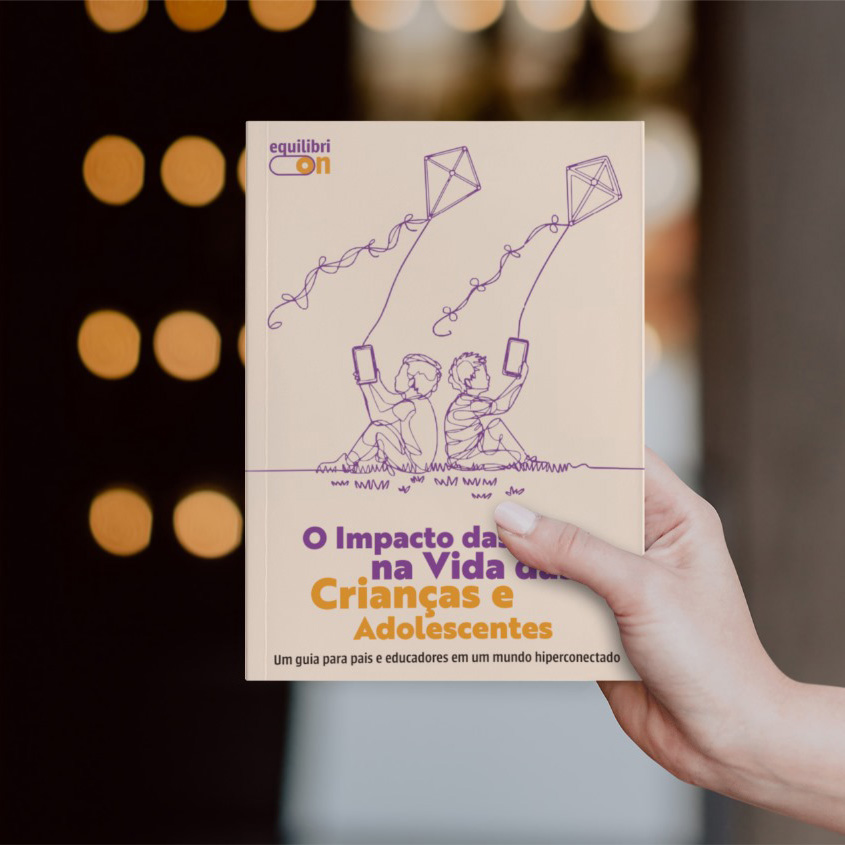
But how can we find a healthy digital balance? In this live session, we will discuss the challenges and impacts of screens, present practical strategies for parents and educators, and officially launch our new book! 📘✨
What Will You See in this Live Session?
✅ Data and research on the impact of screens on childhood
✅ How screens affect family dynamics and learning
✅ Practical tips for a healthy digital balance
✅ How our book can help you!
Watch the Live Session in Full
Profiles of Participants in this Live Session
EquilibriON
Dr. Juliana Orrico
Priscila Assis
🔄 Share this live session with friends, parents, and educators who need this information!
🎁 Special launch offer available for a limited time!
📢 Get the book The Impact of Screens on the Lives of Children and Adolescents with an offer by registering at this link.
Check out the Summary Made by AI
The Impact of Screens on the Lives of Children and Adolescents
Overview
The book launch event “The Impact of Screens on the Lives of Children and Adolescents” featured guests like Dr. Juliana Urico and Priscila Assis, who discussed the importance of digital balance in childhood. The discussion focused on the negative effects of excessive screen use, including behavioral changes, low self-esteem, and challenges faced by parents in setting limits. The implications of the new law banning cell phones in schools and the need for harmony between technology and education were analyzed. Additionally, the event offered strategies for controlling content and screen time, promoting dialogue and digital awareness, concluding with thanks to Editora Europa and a reflection on the future of children in the digital world.
Notes
Introduction to the Book and Guests(00:13 – 12:36)
- Book launch “The Impact of Screens on the Lives of Children and Adolescents”
- Presentation of guests: Dr. Juliana Urico and Priscila Assis
- Discussion on digital balance in childhood
- Alick Mello shares his experience in technology and co-founding Equilibrium
Impact of Screens on Behavior(12:37 – 23:47)
- Behavioral changes in children and adolescents due to excessive screen use
- Discussion on low frustration tolerance and anxiety
- Impacts on self-esteem and unfair comparisons on social media
- Importance of inhibitory control and emotional regulation
Family Dynamics and Screen Use(23:47 – 32:27)
- Challenges parents face in setting limits on screen use
- Importance of parents setting an example in technology use
- Discussion on the need for dialogue and assertive communication in the family
- Strategies for creating healthy routines and habits regarding screens
Technology in School(32:27 – 41:57)
- New law banning cell phones in schools
- Discussion on the balance between technology and learning
- Importance of teacher training to handle technology in the classroom
- Need for harmony between school and family in technology use
Content Control and Screen Time(41:59 – 50:48)
- Tips for controlling content accessed by children and adolescents
- Discussion on parental control apps
- Importance of not demonizing technology but using it in a balanced way
- Strategies for dealing with idleness and lack of offline activities
Challenges of Cell Phone Ban in Schools(50:48 – 01:00:03)
- Reactions of parents and students to the cell phone ban in schools
- Discussion on safety and communication between parents and children
- Need for adaptation and flexibility in implementing new rules
- Importance of dialogue between school, parents, and students to find balanced solutions
Conclusion and Final Reflections(01:00:03 – 01:12:22)
- Presentation of the book in digital and printed format
- Thanks to Editora Europa and the team involved in the project
- Discussion on the importance of digital awareness
- Reflections on the future of children and adolescents in a digital world
Action Items
Unassigned
- Access the Equilibrium website to take the technology dependency test (42:16)
- Buy the book “O Impacto das Telas na Vida das Crianças e Adolescentes” with a discount until February 12 (03:36)
- Follow Equilibrium on social media to receive tips and content about digital balance (01:09:52)
- Participate in upcoming lives and events by Equilibrium on topics related to technology and well-being (01:10:37)
Check out the Full Transcription of our Live
00:12
Erick Melo
Hello, everyone. Welcome. In a minute, we will start our live here at Equilibrium. Six o’clock sharp. Let’s start, okay? Let’s go. Five o’clock. I said six before. Did I say it wrong? So, five o’clock. I want to welcome all of you, everyone who is here in our live, the first live of 2025. I want to thank each of you for being here. I know the routine is hectic, so if you are here with us, it’s because this topic surely concerns you and you want to know a little more about content control, screens, and the launch we will have shortly. When we talk about content control, time in front of screens, access to social networks, TikTok dances, cell phones on the table, hypnotized children, something that seems familiar to many people.
01:27
Erick Melo
Indeed, this scene has become routine in many families, but does it have real impacts? If you have any doubts, you can send them in the comments here, and our backstage team, here with Carol, our entire team will talk to you. We want to bring the comments, we want you to be part of this live so we can discuss here. A lot about screen control and digital balance in childhood. So today is a very important talk about digital balance in childhood with two specialists who understand the subject like no one else. But before introducing them, of course, I want to introduce myself too. My name is Alick Mello, I have over 18 years of experience in technology, I am co-founder and global CEO of Webjunk, a company of iGroup, where I lead innovative projects for major market players.
02:20
Erick Melo
So, folks, I came from technology, I live technology all the time. So, having balance was fundamental for me during this period. And with these 18 years of experience, an invitation arose in 2024, I took a step further as an entrepreneur and together with Bruno Gurgel, who invited me to be part of Equilibrium, I invested and co-founded Equilibrium here with him, which is a startup focused on uniting what? Technology and well-being. Our goal? To help people, families, and why not companies too? We have a very strong B2B work with companies here, to find balance in the use of screens and technology. A real and urgent challenge. And to start, I want to put on the screen here now for you two QR Codes. I have the first QR Code where you can buy the book and the other where you can access our website.
03:24
Erick Melo
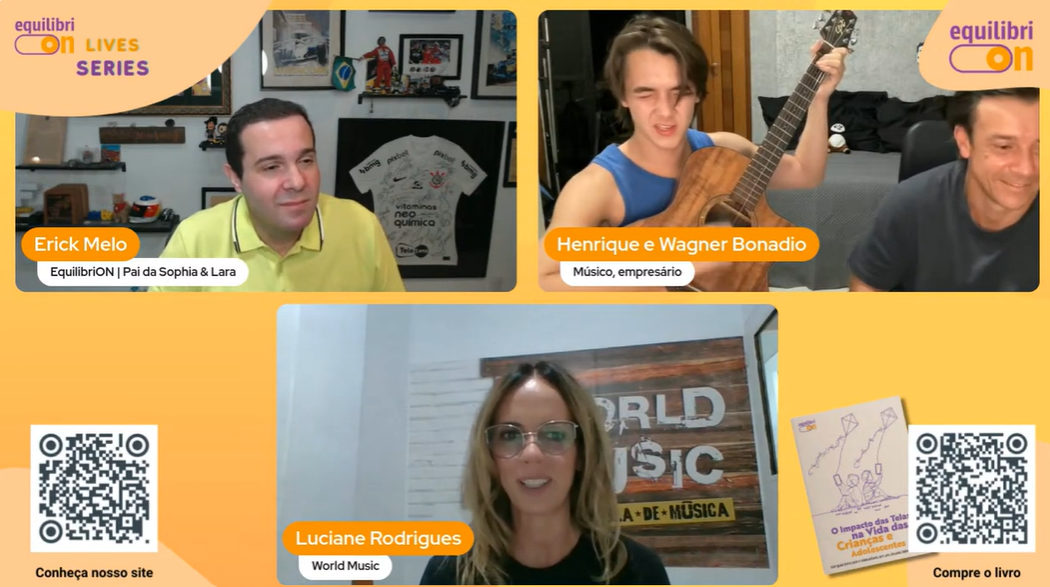
So, click here now, access our website, learn a little more about Equilibrium and also buy the book with a super discount. Get the book with a 30% discount until February 12. This is a special discount we will give you here at the launch of our book. Let’s start now. And to start now, I want to invite here, to be part of this live, my two guests, who were part of it here, oh, folks, I already have the physical book here, such a beautiful thing, who were part of writing our book, O Impacto das Telas na Vida das Crianças e Adolescentes, which is a guide for parents and educators in a hyperconnected world. I invite her, Dr. Juliana Urico, Master in Family in Contemporary Society and graduated in Psychology, she who is post-graduated in Mind Influence, in Cognitive and Behavioral Therapy, Conjugal and Family Psychology, Teaching in Higher Education.
04:27
Erick Melo
Has training in Eating Disorders, Systematic Therapy, Narrative Therapies, Body Psychotherapy, More milk in DMT, stress reduction currently after graduating in sports psychology. Wow! Whew, Dr. Juliana, it’s a pleasure to have you here. Very welcome and thank you for being part of the book.
04:48
Dra. Juliana Orrico
Thank you all for being here today. For me, it was a great pleasure to participate in this project, knowing its importance. And being here today discussing this topic, I think it will help a lot of people.
04:59
Erick Melo
Great, thank you. And I’m also here with Priscila Assis, who has a degree in Pedagogy and is a Psychopedagogue, Neuropsychopedagogue, Autism specialist, graduated in Psychology and post-graduated in Psychoanalysis. She has over 16 years of neuroeducational experience, 10 years of experience working in psychopedagogical clinics, school-family-patient relationships, interdependently with specialized professionals, doctors, therapists, managers, teachers, and the school community. She works as a specialist professor in the undergraduate course in Pedagogy and Psychopedagogy. Priscila, thank you, Pri, for being here with us as well. Thank you for participating in the book.
05:45
Priscila Assis
It’s a great pleasure, isn’t it? As a professional in the educational and mental health field, with all these changes happening, human evolution, this globalized world, there’s nothing better than being with specialists to speak, bring a little light, ease the parents’ tensions a bit, and somehow elucidate this content that is extremely relevant. I’m very happy, very honored to be part of this project, from the brilliant, beautiful, wonderful beginning. Thank you very much.
06:19
Erick Melo
Thank you, Pri. Thank you, and I already want to ask a question here for you, which is, have you noticed a change in children’s behavior in recent decades, right? You already have experience in these last decades, have you noticed a change in behavior? I would like to start with Dr. Juliana, Ju.
06:39
Dra. Juliana Orrico
Yes, quite a lot, right? Because before, we saw technology as a form of entertainment, something much more relaxed, more balanced, right? Today we see both children and teenagers very dependent. And what I notice in the change of behavior, first, is a very low threshold for frustration. So, they can’t deal with emotions, with frustration. And then, it’s something we need to work on a lot with these… I’m talking about children, teenagers, but adults end up being part of this too, right? With this emotional regulation, they are also very used to this thing of information arriving very quickly, so we see a big increase in anxiety.
07:18
Dra. Juliana Orrico
Besides low self-esteem, due to a lot of dependence on social networks, a lot of unfair comparison, which is a term we use a lot in cognitive, when we want to talk about some cognitive errors, and then they end up comparing themselves unfairly to what they see on screens. And then always with the feeling of being less, this affects self-esteem. So, some consequences that have been happening are quite visible in daily life. And parents, not knowing how to deal with it, with the enormous difficulty of setting limits and trying to avoid crises, conflicts at home, keep allowing. But they become desperate with the reactions these children have.
07:59
Erick Melo
Interesting. And Pri, do you also agree with this? Do you think that in these 16 years of experience you have, I would like to understand a little, especially in the educational area, how is this change in behavior?
08:10
Priscila Assis
It’s like this, well, technology is very important in terms of evolution and also keeping up with the times of these children and teenagers. However, in behavior, as Juliana herself mentioned, I think it’s important for us to think, both in this issue of frustration that changes, and then they don’t have something we talk about in neuroscience, the neuropsychopedagogues, we talk about inhibitory control. What is control? It’s impulse. They don’t control very well, they don’t regulate themselves very well, so they don’t control these impulses. You know that decision-making, that parents are striving to put some limits. They are still learning to have identity, autonomy. Then comes the comparison, right, which affects the emotional area, changes behavior, which leads to low self-esteem. In schools, they end up with very low performance. And then, due to comparisons, distractions, some attentional problems.
09:06
Priscila Assis
So, in the test, as the… If we apply some tests, which are sometimes necessary, when we receive a patient, or when we guide in the school group, sometimes the attention is much more linked to excessive use, to exaggeration. It even becomes almost a member of the body of these children. Then the behavior changes in a bad way, right? Which needs to be controlled. And it becomes difficult for the parents. Why do we have to discuss this subject so much? Why do we have to talk? Because by talking, discussing, listening, finding tools, resources, we can do the opposite work, which is prevention. Prevention, right? In Equilíbrio itself, there is a test there, right? So, it’s important to understand. It’s easy to do to understand. From the test, you can think about this in school, you can think about training, why?
09:53
Priscila Assis
Otherwise, we will have aggressiveness. Their behavior is nothing more, nothing less than frustrated, not controlling, right, the emotions. Automatically within the school there is distraction and with this distraction they become irritated. Literally irritated, more aggressive. It’s dangerous, right, the exaggeration.
10:12
Erick Melo
And you mentioned a point here that I was going to address, which is the point where the new law prohibiting cell phones in school, where everyone is talking about it, about this balance of screens. And you mentioned a very important point, which is this impact of the screen on the child’s life. I wanted you to delve a little deeper and share with us here, because it’s a banner we have here at Equilíbrio. I wanted you to share a little… What is the main impact, Pri? I’ll start with you, since you just brought up the topic. What is the main impact? Which is your aggressiveness, I wanted to understand a little more what these…
10:51
Priscila Assis
Then we have to think, I’ll try to put it in a lighter way, brain, right? Cognition, brain, mind. And then think about the stimulus that light, the screen, the speed it processes. We have motor coordination issues, especially for children, which is nothing more than the use of resources there, planet. Why then do we need to guide the school, the parents so much, and need this limit, right? And then the school is taking these measures. Why are these measures being discussed within the school? Everyone is a little lost. Because the exaggeration is causing damage, right? The danger, the risk of that… It’s not conditioning, positive reinforcement, for example, as Júlia herself would work, right? In an intervention, something like that. But it’s the use without limit.
11:40
Priscila Assis
The use within schools brings impact, in this case, negative, when it is not a resource used within the school’s protocol, program, political-pedagogical project, or within an intervention project, because, as we put it, people will be able to see later in the book, right, it is positive as long as the school professionals are trained, as long as the parents learn about cell phones, which is really the control, right, the apps, because otherwise we are talking about attentional problems, right, learning difficulties. Up to about 27 years old, research from child to adult, we can still have neurotransmitter processes, that is, the brain’s conversation to be able to produce, to have better cognition.
12:36
Priscila Assis
However, when you use the cell phone excessively and then you change the resource, for example, from notebook, pen, reading, and stay too much on this screen, with the speed of the screen, with the speed that arrives in a filtered way, we can have problems, for example, attentional, we can have, children can present, for example, writing difficulty problems. Not that writing is totally important, but it can happen, because if it goes uncontrolled, if there is no control, if you lose the hand, there is distraction, we will think that everyone has attention problems, and it’s not like that. And it’s not like that, because it is even trainable. Ju knows very well that we can train, right? We can train skills, we can work on a series of things. But the cell phone without supervision, cell phone without…
13:27
Priscila Assis
Agreements with the father and mother, a cell phone without agreement with the school community, can cause problems, can have a negative impact. It will be positive if it is within the teaching plan. Each child usually has an individual plan, right? Individual teaching plan, it’s what we call PEI. So, yes, in school it would be in this sense. Already within the individual project in the clinic, we also work. We are talking about all children, all adolescents. Can it be used? Yes, it can. It has to have, it has to have agreements, it has to have… I have, right, some cases here of patients who are controlled by the hours, right? You, who are parents, must know how it is. You have to give a counter there, you have to have some agreements, right? Because otherwise the impact can be negative, which is the attentional issue, frustration, inhibitory control, those decision-making processes.
14:12
Priscila Assis
I don’t know if you’ve seen videos where the child acts as if they are having a tantrum, but in reality, they don’t yet have brain maturation. They don’t have a brain prepared like ours to say yes or no and manage this yes or no. And then when frustrated, they haven’t yet learned what frustration is. Sometimes, right, this can be learned at home or with the psychologist, with Ju, or with me too, right, within some social skills training. But if this is not worked on, if there is no prevention at home, for this to reach the school, for everyone to speak the same language, for this globalization to be positive and evolutionary, right, technology in their life, there is the danger of having, yes, some issues of delays. And delay in development, not organic. But, for example, in the student’s performance, right?
14:59
Priscila Assis
This is a risk, yes. Because it’s a lot of distraction, attention doesn’t alternate well, it doesn’t become selective. What is selective attention? I’m looking at Eric now and I’m focused, able to speak, look at Eric and Ju. But I’m not getting lost. If this attention is compromised from selective attention, we will have it when the teacher is speaking up front, when the teacher is proposing some activity, it can be compromised, right? Besides the emotional issues, there are the learning issues themselves.
15:32
Erick Melo
Great! And I wanted to see with Ju, we talked here too, we talked a lot in the context of children, children and adolescents, but I wanted to understand a little now from Ju here, more about this screen issue when we talk about adolescents, right? What are these impacts here that we have in the lives of adolescents?
15:48
Dr. Juliana Orrico
Besides what Pri mentioned there, very well, right? I think the first point is this, right? It’s understanding that, well, their brains are still in formation and development. So, they are much more vulnerable than us, adults, right? To the stimuli they receive, to decision-making, they haven’t yet formed, they don’t have this awareness, this notion of self-responsibility, this well-defined, well-formed self-esteem. Adolescents, usually, one of the things they get most addicted to, I’ll even use this term, because it ends up becoming addictive behavior, right? It’s the use of these social networks that go by quickly, right? And we know that this, within psychology, we call this intermittent reinforcement. So, they are being reinforced, and it goes by quickly, deliberately, to make that content really keep being seen, right?
16:39
Dr. Juliana Orrico
And then, they become dependent on that content. So, a very common statement I hear from adolescents is saying, Ju, I can’t stand doing this anymore. Which is when they keep scrolling their finger on the screen, right? So, this is a very important point. Some reach a point of anguish, others don’t. Others don’t realize they are in this addiction. Those around them notice, teachers, parents, friends. It’s about speaking and not having attention, the adolescents. So, you say something and they say… You never said that. And you said, you explained, you showed, but it’s like Pri was saying. As they lose this focal attention, it becomes diffuse, multifocal attention. And we know we are not made to have this multifocal attention. And then we end up losing information, right?
17:30
Dr. Juliana Orrico
And when they have to focus on just one thing, they sometimes feel irritation, anxiety, and even boredom. Because it’s like, it’s boring to do just this, right? Or I can’t do it, right? That’s the point. And another very important point that I think is, they have access to content that is not suitable for their age. And we know this. What happens? There’s an acceleration, a speeding up in their development, and they are not yet ready for what they are watching or seeing. This comes to mess up this adolescent, to confuse the self-esteem that is being formed. And then there are many parents who say, no, but I put the filter, I put the app. But they break everything, they manage much faster than we shoot and watch.
18:25
Dr. Juliana Orrico
And the other parent maybe didn’t put the filter, he will see it with another colleague, and another, and another. That’s why I think that, like… Our awareness, both as parents and as professionals, for these adolescents, is important. It’s how I will deal with what will come to me. What will come. Exactly. How to work on their self-esteem. This is a very important point, so that they don’t need these contents, these things, to be comparing themselves. I think I managed, I don’t know if I managed to complete.
19:04
Erick Melo
No, the complement was perfect for us to understand a little bit about the brain at the beginning, how screens impact, how… Then yes, apps, social networks, where are they? We have our little cell phone here, right? It also affects self-esteem, as you just mentioned. And then, you talked about an important point as a parent, right? How do we perceive this family dynamic. For me, in my case here, a lot has changed. I’m the father of two girls, Sofi and Lara, aged 10 and 8. And one thing, before balance appeared in my life, let’s say, we, being from technology, I didn’t really see a problem in letting the cell phone, letting access to YouTube, to video, something.
19:49
Erick Melo
When I came across Balance, I started to understand a little more, study a little more, this subject started to become more evident, the trader really, in fact, in Balance, we started to really study, understand how we could change this behavior here at home. And we know it’s not easy, right? Many people say like, wow, are you giving the cell phone to your child? For those who are giving the cell phone to your child? For those who sometimes don’t have a child at home who is breaking everything, don’t know how it is, How this family dynamic needs to be changed? And how we, parents, then it’s a matter of not outsourcing the subject. I always joke about that Jim Carrey movie, Yes Man.
20:31
Erick Melo
Sometimes, we have the issue of saying no to the child, but the issue, when we think about activity, is saying yes to the child. And when we started discussing about, hey, let’s write a book about this. It was before, really, having the law. We proposed the book, we gathered a lot of data about what happens in day-to-day life. And when you come across our book here, you will come across what? With the commitment of parents and school, the growth of screen use and impact on childhood, effect on child development and family dynamics that we just talked about, the influence of advertising and the attention industry. This is very serious. And the strategy for healthy digital balance in the family.
21:16
Erick Melo
So, when we brought all this, gathered this information, we said, hey, we need two specialists here. I wanted to know from you two what made you accept the participation in our book as specialists and why it is important for us to really bring these tips and these details to those who, sometimes, it’s cool, to those who, sometimes, are on the screen? Not seeing, right? So, I wanted to start with you, Ju, talk a little about all these data, about these points that I mentioned, what told you, like, I will participate as a specialist here at the level of Balance, which will be really cool.
21:59
Dr. Juliana Orrico
First, I think the theme, right? As a mother, I see the importance, for me it has always been a very big issue, I always tried, I say tried because the word is really try. Setting limits, sometimes I managed, sometimes I didn’t manage with this issue of the screen, the network, I used apps and Google and everything to make them understand, because the issue is for them to understand the harm, right? So, as a mother, I think this theme is super important. As a psychologist too, because as we were talking here, I have seen the negative impacts. And so, participating in the book and participating in Equilíbrio, for me, is really a way of making a contribution. So, it’s gratifying. I feel honored to be with you. So, I think this is very important. And this issue you brought up about the issue… It’s noisy now.
22:53
Erick Melo
This is the urgency, the police… I found it.
22:57
Dr. Juliana Orrico
That it was something complicated.
22:58
Erick Melo
It happens, it’s live, it’s live.
23:00
Dr. Juliana Orrico
And this issue you mentioned about family relationships, it turns out to be a big impact that we also have, as I was saying, with the impact of screen use, and it has also been in family relationships, because, from the moment we have a loved one, and I’m not just going to mention the teenager, but someone who is in this screen addiction, they will certainly be a person with sleep dysregulation, so it already increases irritability, emotional dysregulation, communication that is not assertive, active communication, so the lack of listening and this ends up generating conflicts within the family. And it has a very big impact. So, the main point that I think you brought up at the beginning, I think it’s the conversation.
23:46
Dr. Juliana Orrico
We work on the conversation in an assertive way, work on the axioms of communication to make the family able, among the members, to maintain these dialogue times, whether during a meal or at some point in the day.
24:00
Erick Melo
And we set the example, right, Ju? I think there’s a… Before opening it up to you, Pri, I want you to respond, but Ju mentioned something here, that I started researching, because I sent it to Bruno today. I have a ring here, which measures my sleep, it measures… There’s a Samsung ring, there’s a ring, this one is the Aura, which measures how your sleep is. I’ve been using this ring since July. And I have here… I don’t know if you’ll be able to see the graph. Here is July. This is my sleep quality. It was getting worse. And then, in October, it changed and started to go up. What changed in October, my sleep quality? Guys, I found this impressive because I talked yesterday and went to research today in my app.
24:40
Erick Melo
In October, it was when I removed all notifications from my cell phone. All. I had set time limits on social networks and I removed all notifications from my cell phone. So, we can see sleep that went below 75, which wasn’t ideal, and it went above 80, right? So, that’s what you said, it’s the example, right? I think the book will serve a lot for parents and even teachers to have the opportunity to have an example at home, what I can do with my child, what I can do with myself, right? So, it starts with us, so, Bruno always tells me, right? When we, when the plane is falling, some problem on the plane, there’s always a mask that falls, right? And then first who puts on the mask is not the child, right?
25:30
Erick Melo
You put the mask on first and then you put the mask on the child. So this shows, this result here that I have here today, shows results because I put the mask on myself first, because the first affected was really me, and I needed to set an example here at home. So, I think this was also one of the reasons that inspired us to make this book and invite you. So, I think this part about sleep, I wanted to give this example, because when you talked about sleep, this came up, I came to look for it, I found it really cool. Pri, you, what inspired you to be here with us in the book, Pri?
26:07
Priscila Assis
Well, first, the psychoeducational process that ends up happening, because it has a social function. A book has a social function, right? You will have, you will still have all this balance in digital, print, the writing process, learning with you, the exchange, I really believe in the exchange, reading each other’s material, the data is impeccable, okay, folks? Look, it’s impeccable, solid research, right? And the way it’s being handled, from organization, it’s very pleasant, very nice. But think with me, a child, right? A child is smaller. If we think about a basic issue, children and adolescents, they depend on their parents. When you talk about the example of bedtime, the example of not looking at notifications, it’s perfect. Because children observe, father and mother are home, right? I say this to all parents.
27:01
Priscila Assis
I joke sometimes, to be nice on the day of conversation, that it will be a little difficult to put the bread. I touch like this. I thank you.
27:14
Erick Melo
It froze a bit, Pri.
27:22
Priscila Assis
Did it come back?
27:23
Dr. Juliana Orrico
It came back.
27:27
Priscila Assis
So, let me go back here. So, let’s say your wife, Erick, is the queen and you are the king. And in this castle, there are two princesses, as you mentioned. And these princesses need good examples, customs. Then I call it customs, habits, and culture. If within this house there is the culture of bedtime, time to wake up… All family members are well treated, and then the girls can look at this example, it certainly becomes psychoeducational.
28:01
Priscila Assis
It means they are learning by observing, you don’t need to keep telling them so many times, because they are there, if it’s written, if you are going to talk, if at the time there is no cell phone at the table, you will ask how the day at school was, then there will be an opening for dialogue, they can cry, feel, speak, say how it was, get angry, you will be able to observe more, but the example is sensational. So, being able to talk about such a pertinent topic as this, current, right, which started before this law came out, including, which now became more pertinent than anything. But being able to understand that the simple, the trivial, being done as an example, then we are on the right path, right? We are on a path that is an ant’s work.
28:43
Priscila Assis
Little by little, your girls, Ju’s children, my nephews who know they end up having Aunt Fri as an example too. It’s not just father and mother. If it’s a castle, there are lots of people in the play. If it’s a house, if it’s home, it has to start at home. It’s very nice. I have my wonderful mother here. It’s so much that comes to our ears, even today, as adults, things learned from mother and father, that make all the difference in difficult situations. So, father and mother…
29:16
Erick Melo
This is something that has been lost a little. In the past, we used to stay on the street with our parents, talking to the neighbors.
29:23
Priscila Assis
There was that issue… Sitting on the sidewalk, right?
29:26
Erick Melo
Of telling stories, learning at home, not learning on YouTube of life. I think that…
29:33
Priscila Assis
Yes, for example, a game. Isn’t there a game you like, Erick? We were talking a little before here backstage, I found it sensational you talking about the Senna movie and your daughter watching it. She watched it with you, she had quality time with you. She was moved, she felt comfortable, she was with her father. So, example, the choices we make, adults make around children. Adolescents suffer, literally, that’s the word, right, Ju? You can correct me if I’m wrong. A disequilibrium, process of… Identity issues are under construction. The third world is always under construction, but the adolescent has a disequilibrium that is very Piagetian indeed. That is the process of assimilation and accommodation of external information, right? To learn to internalize what is mine, what is the other’s. So, it’s difficult. And they will respond.
30:23
Priscila Assis
It’s difficult for parents, isn’t it? Because they will give those answers that won’t be pleasant. So, if you don’t have the example and don’t make those agreements and don’t follow the agreement, they will question, because they are learning how to be thinkers, right? So, the example is super valid. Therefore, working with family makes sense to me. That’s why I’m part of this project, which is beautiful. This refined, loving, respectful view, without being too strict, but balanced, like the balance the startup itself has, right, from Instagram here. It’s very clear. Here everyone practices sports, likes sports. It’s not something… It’s part of our lives. So, the children are watching, the teenagers are watching. They see that we are… We are valuing life as people and professionals, right? The screen cannot be more important.
31:11
Priscila Assis
The screen is part of the 21st-century context, right? I remember when I, Priscila, 42 years old, took an internet course. Things weren’t easy, and I took an internet course. Today everything is very easy. My nephew is turning two years old. He touches any television device, any that has touch, and knows how to change it, and asks for the cartoon. Then the aunt steps in, right? There will be that control. Why? Because he needs things that are pre-editors, right, Ju? Children have predictive issues, things that must come before the screen. Due to a matter of child development. Adolescents have very serious emotional issues. Also, it’s before the screen. So, if there’s an example, parents must be understood as authority. How do we establish authority without authoritarianism? With example? There is theoretical foundation on this.
32:03
Priscila Assis
This is what we learned from our parents in our age group here. It makes sense to me. I can get angry at whatever, but I remember my mother’s little voice. I remember, we remember issues that…
32:14
Erick Melo
I made a video today about this. I made a video, not today, yesterday, that we will post on social media, it was raining, I was making a video in the rain, which is about just getting out of the rain, kid, right? It’s really… Today it’s get out of the screen, right? Instead of getting out of the rain, it’s getting out of the screen and going into the rain, right? I think we need to go back to going into the rain.
32:35
Priscila Assis
No, and actually, sometimes people think like this, we, in our case, in the middle of the rain, we work in cognitive behavioral, for example. I work with psychopedagogical and neuropsychopedagogical. So, when we work with reinforcers, autism spectrum, I do the naturalistic, right? But there are reinforcers. And the cell phone, to be positive, cannot be the reinforcer. With this book, with our discussion here, or with any process of trying, as Ju herself said, to understand what your child is like, what your teenager is like, your child, The ideal is to be careful not to replace other things. The household routine, quality time, during meal time. If you don’t set limits… It doesn’t work. If you keep replacing, you condition. I see this a lot in shopping malls out there, on the street.
33:28
Priscila Assis
Handing the cell phone to the child to keep quiet to eat. When, in fact, the child needs to see you using… Why do we make a lot of mess in the clinic, right, Ju? Because we are using materials, from recyclables, lots of things, for children to learn the importance of their own body, to move, to understand the external environment. Then you give the cell phone, So, the toy is no longer fun, mom and dad there aren’t. Seeing mom and dad use it, won’t learn, will have their head down, won’t have a good posture. The teenager, how will the teenager socialize with mom and dad? If you don’t ask them to put away the cell phone, if you don’t tell them at the table, I don’t want it, please.
34:09
Erick Melo
And I think you mentioned something important here, which is the issue of real challenges that parents are facing. When we did the book promotion work, we included in the registration, in the coupon to watch the live, to receive the book discount, the comments, a comment area where the parent could share what was happening and talk about what was happening with them. And I have some here, some comments from some parents who posted there, and I wanted to discuss them with you. I’ll read some, even for us to see what these challenges are like. So, the first one, here in my notes, look. Concern about screen use by nephews and grandchildren. I think a lot. Idleness and lack of activities during the week. Does it lead to screens? I’ll do it as if it were a chat here.
34:59
Erick Melo
Ju, idleness and lack of activities during the week. Does it lead to screens?
35:04
Dr. Juliana Orrico
I think so. You know why? I found this interesting, while Pri was talking and you mentioned it, I was ready to talk about it. But I’m even afraid to get into the next questions, right? I’ll try to summarize. It’s no use telling a teenager, telling a child, no. Like, you won’t do it. Why? Because they are dependent and addicted to it. Then they go to the feeling, which is the feeling of boredom. But they are children and teenagers, they need to be creative. There are many parents who say, use creativity, but don’t give a suggestion, don’t invite them to do something. So, I think if we want to help them, we also have to suggest, we also have to come up with alternatives.
35:49
Erick Melo
Question from dad. Can I?
35:52
Dr. Juliana Orrico
You can.
35:54
Erick Melo
We talked about creativity. In the past, we sometimes had a ball or a bicycle. I remember playing travel, taking my bike, staying on a dead-end street, thinking I was going to Portugal and back. But why did we have that? Have children forgotten how to play and we didn’t teach them how to play? Is that it?
36:17
Dr. Juliana Orrico
It could be, or they were taught, but social media is more inviting for them, because we also have to remember that it’s their culture today, it’s where they flirt, where they talk, where they live, so it’s more attractive. Even if they learn the other, it’s more attractive. But the question of idleness, of course, we have to stimulate the bone, obviously. But I believe a lot, and it’s really my own view, that you give activities, sports, which I’m passionate about, I think if you put the child in sports, whatever the movement, they will be in a group, they won’t be with the screen, they will have notions of limits, of discipline, they will be releasing there, chemically, both for the brain and for the body, everything they need.
37:01
Dr. Juliana Orrico
So, I am very much in favor of, in time, outside of school, having some moment that can practice within the family’s conditions, but not staying at home, with nothing to do, in a dark room, with the curtain closed and the computer on, or the cell phone.
37:20
Erick Melo
And then, at this point, I want to bring it to me, which is another comment posted here. That the person establishes a good balance at home. What bothered them was the use at school by some children, which generated requests and discussions about when she would give the cell phone. Well, my friend has a cell phone. My friend has an iPad. Why can’t I have one? Now that everything is banned. So, Pri, I wanted you to talk a little about this. Sometimes I can maintain balance at home, but the neighbor doesn’t, and I think it’s what Ju mentioned. The issue of idleness and the need to also use technology. I think not being too radical. Tell me a little about this.
38:06
Priscila Assis
Ju put it well, the children, the teenagers, we are talking, they are in the century, it’s their century, it’s their moment, technology is part of it. That’s why the pre-pedagogical project, which is nothing more than an annual, semi-annual project, the organization of subjects that teachers do, includes digital screens, includes, for example, them using quizzes, which are used on the cell phone, trying to answer questions on the digital screen. So, there are lots of cool things. But this, we can control over time, which is also over time. It will already be written in the proposal. Then, at home, for example, parents have the resolution, have as organization, culture, acts, customs not to use. What is important? It’s the so-called harmony, which seems like a very cliché word, but, like, it’s difficult to establish. This requires a willingness from both parties.
38:59
Priscila Assis
So, like, you know the school, you chose the school because it’s culturally important to you. Your child is important to you, he is developing and is part of the technology culture. There needs to be a conversation, there needs to be alignment. If it’s exacerbated either at home or at school, there will have to be harmony, there will have to be balance in using this resource. It has to be used as a complement, as a resource, as information. So, that’s why these prohibition issues arise, right? Then the little friend. It needs to be strengthened, right, Ju? We will have to strengthen this child, these bonds at home, so that this habit, right? This family culture, this family dynamic at home is so strengthened that this child feels a little better, but not so sensitized by something external, right? Now, is it worth a conversation?
39:50
Priscila Assis
It’s worth it, for example, I go to schools a lot for this reason, just to give a lecture, sometimes a circle of an hour or 90 minutes, for us to talk only about technology. We will talk only about bullying, we will talk only about topics that are relevant there. Conduct a survey with that school community and see how it is. Is it relevant? It’s something to listen to, it’s something to take to coordination, direction. To discuss, to enter into harmony. Shall we find a balance point, for example? So, okay, folks, I’m holding here because there are 10, 11 years, 12 years I allow. Before I don’t allow, this is an issue at my house. Can you help with this issue at school? Let’s raise awareness, because children, school is the child’s society.
40:31
Priscila Assis
So, like, if you treat it at school with this care and then the child listens at home and also listens at school and speaks generally, everyone wins. It’s not a rule, it’s not something we will be able to do without having this awareness process. There has to be the awareness process. Then there will be more balance. It’s not a guarantee, right?
40:53
Erick Melo
Exactly. And then I have a point here, two points, actually, from the comments we have here in our chat and also that were made there in the book comment. The biggest difficulty is establishing the rules. We talked about having a conversation, but sometimes, how is this difficulty in establishing the rules? And here I have Renata Guimarães, who sent a message here to us, look. Because of screens and games, my eldest son refuses to go down and play in the condominium. If the screen is cut off, he stays in the room, lying on the bed, bored and grumbling. Ju, how do I establish the rules, Ju? Since… The screen is already associated with the daily life of this child or teenager?
41:40
Dra. Juliana Orrico
It’s a challenge, right? But let’s go. I’ll go by parts there. What I would do in this case and in the first question? First, if the teenager, sometimes, is already in a way that communication is difficult, he understands and perhaps needs a professional, professional help. Since she realizes that it’s not good, lying on the bed, I would already go for professional help, okay?
42:04
Priscila Assis
A little intervention there, right, Ju?
42:05
Dra. Juliana Orrico
A little intervention, yes. Because not to take… And sorry even.
42:10
Erick Melo
Cut you off, remembering that here on the Equilíbrio site we have a technology dependency test. So you, dad and mom, who want to test with your child, and there’s one for you too, okay, dad and mom? If you want to see if you’re addicted or not, go to the Equilíbrio site, which has tests for parents and children, where you can see at what level your parent is, and if really, as Ju just said, you need help, right, Ju?
42:33
Dr. Juliana Orrico
Yes, because sometimes, even if there is no dependency, okay? Because sometimes there might not be dependency. But the illness, let’s put it this way, the pathology is masked by excessive screen use. So, if a teenager is depressed, a teenager with something else, they will be there in that excessive use, which they are not even dependent on, but they are hiding there. And then, when you take away that subterfuge, that escape valve, you can recognize what is there to treat. So, there are these two aspects that we have to be attentive to. Many parents ask me like this, but, Ju, when should I take them? The first thing is to be attentive to the child who is at home.
43:11
Dr. Juliana Orrico
So, if you notice a change in behavior, clothing, eating, sleeping, a very large emotional instability, these are already points where I would intervene. Another thing, set the rule. It’s difficult, because it’s no use saying, being a parent is wonderful. I love being a mom, it’s no wonder there’s a competition here at home, there’s a lot of people. But it takes work. Because it’s very easy to be a mom and say, I don’t want conflict. Then you let it go. No, otherwise there will be confusion, it won’t work. There are days when really, there are days when we’re not okay. And then, we also have to recognize our limit. To see when we can assertively put it to them. But we won’t always be assertive, because we’re human.
43:58
Dr. Juliana Orrico
We also have stress. So there will be days when a mom will scream, a mom will lose her temper, will pull the cord, several dark stories like that. Because it’s difficult to set limits, because that child is not listening to you. And not because they are being rebellious, but because either they are already dependent, or they are having difficulty, they won’t listen to you. So, in the book I even put some tips and such, but obviously I think it’s cooler with intervention, but these are things that can be done at home. The first is to improve communication. So, this mom, who put it in the comment, is to bring this child closer to improve communication, how. What does this child like to do, besides gaming?
44:45
Dr. Juliana Orrico
And do it with them, because sometimes the parent wants to invite you to something they want, and that is not the child’s. Watched something, you talked about the movie, I found it super cool, but sometimes the child doesn’t like movies, and then you’re inviting them to watch a movie. So, what do you want to do? Even on the day you actually play, sit down to play together or ask about the game. But you enter their universe, to start building a communication path. And then have active communication. And then besides that, other practices like sports, short meditation, doing it together, bringing them other options, I think she will be able to set this rule. It’s no use saying, go down to play, or then, the sun is out there, and you’re here inside.
45:29
Dr. Juliana Orrico
I’ve said this several times, that I love the sun. I praise the sun outside. Even though it didn’t help at all. Now that they’ve grown up more, they enjoy it too. But we perceive their reality, and within their reality, bring this communication.
45:46
Erick Melo
Cool. And then, when we talk about the school issue, I think this is a… As we put it, as Pri put it, school is the children’s society, that’s where they are living, where they live, spend more time, sometimes, there than at home. There’s a point, I think it’s very interesting, which is precisely what? When we want to change a society, we really need a law to do that. Remember the seat belt? In our case, I’m going to turn 43 now, on February 19th. I’m going to be 43 years old, I was from the time when there was no seat belt. A law was needed to use a seat belt. What did my father and grandfather do? You have to put on the seat belt, the thing tightens, right? And today everyone, it’s natural, if you get in the car, already put on the seat belt.
46:32
Erick Melo
Same thing with smoking on a plane, same thing with smoking in a restaurant. So, Pri, I wanted to know from you. Without the law, the work you do at home, do you think it would solve anything in schools? Even with the very well-done work that I managed to do at home, if the law didn’t exist, would teachers be able to help with this issue? Not outsourcing, okay? How would this interaction with the cell phone be at school?
47:02
Priscila Assis
Well, it’s important to remember that, as we mentioned at the beginning, all the work done by independent women, each in their space, each in their place, when I know my place in the family, the place of family responsible for the child or adolescent, the place of school. If we try, if at home there are habits, customs, if this is part of everyday life, it can indeed have good results. Now, it will be surprising if there is a law, for example, you can reach an agreement, I already know of schools, for example, that have already started to reach an agreement, have already started to improve because they made this bridge. You know, this bridge of, in harmony, starting to establish, no, wait, let’s make a turn here, there will be a lecture.
47:48
Priscila Assis
To get used to the seatbelt, you don’t have to say, estornuler, and then everyone puts it on, don’t we put it on conditionally? So, the school will have to behave differently, from entry to exit time. The routine, just to add to Ju’s, routine. Within the routine, if you put what is allowed at home, what is allowed at school, and also what is not allowed, because a very assertive communication, the tendency is to be very successful. You have to explain, they will question a lot. Children and adolescents today, even in a positive way, right? Positive. They know how to question a little more, right? They question more, they ask more. Because there is a lot of information. When you are in a school that values this assertive relationship, this good communication with the family, you can do the work. You have to do the work, actually.
48:40
Priscila Assis
Training for the teachers themselves, because we also have to work with the team, which is the school community. The school community includes family, teachers, the door staff, the school van staff, everyone. It’s no use everyone… Driving while using the cell phone. If I see it, I scold. If it’s my nephew, I want to die. With the cell phone at the wheel. So, you know? So there are a lot of things that it’s no use just blah, blah, blah. I don’t remember who owns this phrase, but like, example drags. You know the example drags? If you don’t want to have a problem, if you want to get it right, create a routine that is liberating for you. A friend of mine was fascinated by the book that Guimarães entered. And so, you have to have a routine that makes sense to you. For you. But it’s nice to think as Ju said.
49:31
Priscila Assis
The routine cannot be for everyone. Because that doesn’t exist. You are raising people, right? Everyone is raising people. Citizen, boy, girl. Anyway, your children will become adults one day. And a lot remains from childhood and adolescence. But a lot remains. So, the effort is worth it. I swear, folks, the effort is worth it. You will spend more time educating, but the result is so positive at home. It’s that thing. You have to have a liberating routine, with minimal control. Break the rule on Saturday, on Sunday. Break the rule on Monday, if you can. And it’s all right, right? I think that’s the point.
50:08
Erick Melo
It’s all right.
50:12
Priscila Assis
It’s all right. Ju knows well, we talk about planning and mental flexibility. What is this that we work on? We have time to attend, we have moments, but if we receive a pain, something that arrived at that moment, we stop everything in the schedule and listen actively, technically, with a floating attention. I am a bit of a humanistic psychoanalysis too. But anyway, with all the attention there, completely focused. On that child, on that adolescent, on that person. And this is what will have connectivity. This is what will form the legal resource of technology, but not more important than human exchange, you know?
50:54
Erick Melo
Perfect.
50:54
Priscila Assis
So it’s possible, it’s possible. But there has to be work. It’s not easy, no. The book has a lot of things, just to let you know.
51:02
Erick Melo
There are many tips in the book, folks. Many tips. And one of the things that many people mentioned here as well, reducing usage time and video restrictions. My biggest challenge is controlling the content. I find managing time easier. So, the other one here, we don’t have much difficulty. However, as we use the phone a lot, the children also want it, which is the example we talked about. So, I think this issue of content, this one, I wanted to give this tip, the issue of controlling content and controlling time, both Android, if you have Android or if you have iPhone, you have in the app itself, already, the ability to control the time, know what they are accessing, and set family limits. For example, on the iPhone, I can set up my entire family that is integrated with me, right?
51:51
Erick Melo
And I can establish the child’s age. This is in case I have other people who have phones and can do this control. So, you can have control over what content. So, if there is an app that is restricted for their age, this app simply won’t open. So, you are managing to control the content. So, in the book, we have some tips on this, but there are also a series of apps that help with this. And then, where I wanted to get to as well, is the matter of not demonizing technology. As Priscila said, as Ju said, no one is demonizing. Want to spend a little time in front of the screen? Go ahead. There’s no problem at all. The important thing is to be aware of the time. As Rey said, gosh, my child doesn’t want to go play soccer, doesn’t want to go play soccer, doesn’t want to go down to the condo.
52:43
Erick Melo
So, gosh, how can I do this work, where I can sometimes use the phone really for this? We talked about screens, watching a movie? I was on a screen watching a movie. But it’s something… Constructive, right? I have many examples, my daughter, she is in an international curriculum now, she needs some apps. The other day, I saw her on the screen, I said, “Hey, Sofia, on the screen again?” She said, “No, dad. I’m passing the Duolingo level because I’m practicing German.” I said, “You can feel free on Duolingo, then.” So, we have things, we have apps that help us. There are apps that teach how to have tasks and experiences with children. We talk about this in the book too.
53:31
Erick Melo
So, as we are talking about the book, and the question doesn’t want to be silenced here, what can the book do to help these families? Ju, what can the book do to help these families, besides these little tips I gave here?
53:43
Dr. Juliana Orrico
I think that, besides these reflections we are having, it’s precisely this, right? What strategies will be there to help children in managing, in balancing screen use. How to help those who are already dependent to treat themselves, to take care of this dependency. Because I think that, like, reflecting, discussing, I think it’s excellent. But one thing I hear a lot is, and now what do I do, right? So, and I think the book has this great aspect, that we managed to bring this, right? What strategies to use to help. I think this is the main point there, that I would raise in the book. Besides everything we discussed here today, which is already in the book, right? But I think it’s about how to manage and what to do, what techniques to use. Pri?
54:31
Priscila Assis
Yes, what we included, which is also in the book, people will be able to check, are some suggestions and actions, right? So, there are questions and some suggestions, right? To be able to reflect. So, you can reflect from this, once it’s work, right? That has research, solid research. Our contribution made a lot of sense to us and I believe it will make sense to many families. And, like, it’s something that adds, right? What we worked on was to add, to sum up. So, these are suggestions of simple tips that you can do in what is in your home, that you can create. Wow, there are so many artists at home that I know can make a written routine, that can work on communication, do…
55:15
Priscila Assis
In writing, each will put their opinion on why not to use the screen. You have to discuss, folks, with them. You have to talk. Try to bring this to dialogue, right? And from this, I’m sure it will work. The contributions of the book lead parents to reflection. I believe it adds to society, adds to the school, adds to the family. For us, it’s enjoyable, imagine for the people.
55:39
Erick Melo
Exactly, it’s light, it’s easy to read. And another thing I found nice, which you just mentioned, folks, at the end of each chapter, right? We have here chapter 4, the effect on family dynamics. At the end of the chapter, I have questions for what? Questions for reflection, right? So, here, how is the use of technology impacting the quality of family conversations? What is our reaction when we try to turn off our phones for a while? How have devices influenced the tension of giving to each other.
56:11
Erick Melo
So, there are questions here, after you read the chapter, in each of them, children’s development, the growth of screen usage, we really bring this reflection, which is precisely the moment where we stop, just finished reading that chapter and say, wow, it’s true, let me ask myself what I am doing and what is happening at home. So, I think… This was one of the things, these reflection questions, and this issue of us being able, through these questions, to have this action from families, where we will be able to take action, not just the family, but also the school, like everything, is fundamental. I really liked what you mentioned. And I wanted to know, here too, if, folks watching us, feel free to send questions here to Priscila, to Ju, okay? The comments are open.
57:03
Erick Melo
Renata mentioned one more thing here, look. My son’s school prohibited any use of cell phones at school. And I saw at the meeting parents angry with the rule. I couldn’t believe it when I saw parents protesting.” She put this in a legal point. I also went to a meeting. I went to two, right? I have two girls. And the school already said there, use of cell phones is prohibited. Then a mom raised her hand and said, okay. My daughter can’t even bring it and leave it turned off? Everyone was… Questioning. Why? Her daughter comes to school by bicycle and the way she knows her daughter is okay is because she can track where her daughter is. Are there other ways to put something on your child to see where their route is? Yes, the cell phone, in this case, can be very good.
57:58
Erick Melo
So, there are still some questions, according to the Senova Law, I think they will arise. And this issue of angry parents, really, is that I think… The penny hasn’t dropped yet, right, Pri? For these parents?
58:14
Priscila Assis
Let the parents be welcomed. Ju will be able to help me a lot with this. It is not for us, professionals, to condemn or judge. Not at all. That is not our role as professionals. We welcome, we listen, peace, we listen to colleagues, we listen, we try to understand. This law was not made by chance. It will still raise many hypotheses. But it wasn’t by chance, it’s a concern, we’re talking about screen addiction, we’re talking about dependency problems, areas of the brain, affected organic part. So, the first thing we have to think about is the well-being of the children, the adolescents, and ourselves, because there will be a big change in behavior in the internal relationship with schools and parents.
59:01
Priscila Assis
It’s that every change, if you have a way that is going one direction, you change to another, everyone will complain. Change is not something so comfortable. Almost nothing, right? And still entering this content will require training, we will have to welcome these teachers, the management team needs to have a refined look at the teachers. We, professionals, when welcoming in the clinic, we also have to have a very good listening with these parents, propose suggestions for an organization that is liberating, not something stuck, you know? We can’t live without it anymore. Technology is part of our culture. And it’s positive as long as it’s used as we also can’t go without sleeping, as Eric commented. We can’t go without eating. We already have some organizations in our routine that make things work well.
59:49
Priscila Assis
There is an amount to work with, the parents who work from home. So, it will have to be. That’s why reflections in the book, questions, open up for the children. Try to understand in the child’s language. Do not talk to children as if you were talking to an adult colleague. Do not talk, for example, do not attack the teachers. I am a teacher, folks. We really like what we do. We are here to add, to contribute. We are discussing a book that generates changes, that has a social function. We are talking about something that is painful, it is a pain. So, it is very important that we listen, that we welcome ourselves, professionals, this father and this mother, to understand why they are upset.
01:00:27
Priscila Assis
He is afraid, the mother is afraid of not being able to look at the GPS, look at the app to see if her daughter fell, if she reached the final destination which is the school, if she returned. Each has a dynamic. So, there must be a bit of… Empathy, patience, we will have to deal with this. Adults have to deal with it, there is not much to do. We will have to take care of the children.
01:00:49
Erick Melo
Carolina Pamplona also mentioned here, especially about this, right? I saw many parents complaining about the security issue. I myself, if my child were older, would be thoughtful about how to solve it. So, it’s what you said, right? How do we solve this? And then, the point I wanted to bring to Ju here is the following. And we are talking, when we talk about the number, the growth of screens, we are not just talking about private schools, we are talking in general. Some important numbers here. We have more than 181 million users, total internet users in Brazil. The time spent on the internet. Folks, this number is absurd. Bruno always says, I go crazy. Daily time spent on the internet, adding all devices, 9 hours and 32 minutes.
01:01:46
Erick Melo
If we have 24 hours, I have 8 hours to work or study, I have 8 hours to sleep, and I have 8 hours to have fun, someone is not taking a shower, as Bruno says. So, we saw that, folks, the time on the internet, the time on mobile phones, 5 hours and 28 minutes. Daily time on tablets, four hours, the time is very long. And, Ju, at this point, we talked here about how a state school, in the city hall, or the government itself, besides setting rules as law, how can that teacher there help those children? Because we know that this problem is not just a YouTube issue. There are games, there are many things happening, bets, right? So, I wanted you to talk a little about this too.
01:02:43
Dra. Juliana Orrico
I think teachers need training, right? It’s like Pri was saying there, first reception, both parents and teachers need it. I understand the outraged parents, because as a mother, I was initially scared too, because I was worried about the children, because I put the life on them. To know where they are. And I said, and then, won’t be able to even take and leave it off and such, but I understand the importance, more than ever, studying even to be here speaking, I know the concern with the use of screens. But I think it’s something we will adapt to over time, will understand how this dance will be. And within this context, we have patience to adapt to this and help these teachers.
01:03:29
Dra. Juliana Orrico
Because if it is not a joint work of school and family, it really becomes very difficult. If it is a condemnation from one side or condemnation from the other, it will not work. Teachers, if you talk to some teachers, I saw many years ago, you see several reports stressing out, leaving the room, not enduring anymore, because there is no listening. Teenagers either sleeping, because they spent the whole night awake, probably using screens, or in the room fiddling and pretending to pay attention and not paying attention. Some even stop complaining. So, we have crossed the limit with this. I think it’s really time to review and see how it will work, how we can help parents, teachers and really do training in schools.
01:04:16
Erick Melo
Perfect. Folks, we’re reaching the end of our live, right? I want to thank you for being here, but before we wrap up, I’ll let you speak a little more, I want to bring some questions from the audience, also some questions that were asked beforehand about the book, about the work we’ve done here. So, the first one, the book in digital or printed format? Folks, it will be both. I have the printed one here in my hand, but it will be released in print soon, there will be a launch date probably after Carnival, because we’ll have more copies available, so you will indeed be able to buy your book at major bookstores and specialized websites. Digital, there’s also the digital version.
01:05:10
Erick Melo
The digital version, we’ve put it here in the chat, you can, there’s a QR Code there too, you can buy it on Amazon. We have a special price on Amazon now, we’ll also be at Editora Europa, which is the publisher that published our book, I’ll thank them shortly, we’ll also have the book launched there, but the focus for this first launch is on Amazon. So, folks, grab the Amazon link, send it to a friend, send it to the school group, because it’s really a topic that will help a lot of people. So we have the digital version, if you want to see it on Kindle, want to see it on some other hardware, you will be able to see it digitally, or if you, like me, prefer printed books, where you can scribble, you will also have this possibility and it’s beautiful.
01:05:58
Erick Melo
Speaking of the beauty of the book, I want to thank Editora Europa. Editora Europa provided all the support for us, helped us with great care, did it with much love. Luiz Siqueira, Marco Clivati are also the parents of this wonderful book that Editora Europa provided here with us. The art is wonderful, everything is perfect. I wanted to thank the folks at Editora Europa. And the final closure here couldn’t be without reinforcing the importance of digital awareness, folks. So, I want to leave some space open for Ju and Pri, for you to leave your last messages and speak from the heart, what you really want, what you expect for the future of these digital kids, these digital teenagers who are on social media? I wanted you to speak with much…
01:07:05
Erick Melo
From your experience, what do you expect, what tips do you give for this final wrap-up? Just a quick round to close the live here. I’ll start with Pri.
01:07:21
Priscila Assis
Well, folks, I think we have to face it positively, right? As an evolutionary process that can add a lot to the school environment. At home, dialogue, dialogue, dialogue. When we start talking, at some point they will learn to listen too. And understand this as evolution, right? And if resources are needed, which is sometimes what’s missing, we have questions but no answers, right? The book, right? Our book is a good option for you. So, you can acquire it, try to understand a little, foster more discussion at home. For educators too. And then, we can start to chart a path, right? As everyone needs a method, a path. So, a path to reach a good place, a place with balance.
01:08:01
Erick Melo
Thank you. Thank you for being here. Thank you for participating in this project. Thank you. And let’s change this scenario, Pri. Thank you very much indeed. Ju, your words.
01:08:13
Dra. Juliana Orrico
I… I hope, right? I was even thinking here while she was speaking what I really hope, but I hope that the children, and so, I think a lot about my children when I talk about children, but in general, everyone out there, that they can enjoy life, you know? Like, live life in a way that is worth… I have a phrase that I really like from Marsha, who is from DBT, where she says it’s a life worth living. That they can be present in the moments, because I think excessive use takes away our presence, we can’t perceive, we can’t enjoy, we can’t live with balance, with harmony, without needing this fast-paced, frantic thing. So, that we can be present. I think that’s it.
01:08:57
Erick Melo
I loved the phrase and this presence, it is certainly the presence of dad and mom, and us being together with our children, to truly see a less disconnected future. We know that the future tends to be digital, artificial intelligence, all of that, but this relationship, the eye-to-eye, we talk a lot about it, right? The eye on the book, this exchange we had here, this exchange we had with you, who is following us here on the live, this eye-to-eye is what we really hope for moving forward. So, everyone, I wanted to thank you, Ju, as well, for the words, for participating in the book. And you, who are here with us, who followed our live, our one hour and almost ten minutes of live, we are wrapping up here. I want to thank you all for your presence.
01:09:47
Erick Melo
I want to tell you that you are not alone. Count on balance, follow us on social media, visit our website, we have a lot of content that we post, many tips that we give daily, there on our social media, on Instagram, on LinkedIn, our blog, we have a new website, take a look there, get to know a little more about our work. It’s important to mention, we are talking about parents, children, school, but we also work with companies, we know that mental health is also very important when we talk about the business environment, the corporate environment. So, taking care of health, whether it’s our children’s or especially our own, right? It’s essential. So, our next actions that we will have, let’s continue with this live, right?
01:10:36
Erick Melo
This live series, we are at the book launch, but there are many new things, there is already a list of many great people. We will talk about the importance of music, we will talk about the importance of bringing children here to the day-to-day and also talk about lives that we will have in B2B, talk about technology, how I can use technology to our advantage. So we will have many events like this. Talk about our in-person events, if you love school, if you want us to help you, help the community as well, we are entirely at your disposal, because that’s what we want. We want to raise awareness among people, and this is our work. Not only on social media, not only with the lives, not only here in the Digital, but also in all corners here of this Brazil.
01:11:28
Erick Melo
And for the end, I want to thank the entire Equilibrium team that helped us, whether it’s the marketing team, commercial team, back office team, thank Bruno, Carol, Caróis, everyone here, the video team, these tireless people who work with great purpose here. And if you want the book, just comment there on Instagram, put “I want” on the live post, and you will receive a message there, there will be a nice automation for you to receive the link with the registration for the discount we are giving. Everyone, thank you to everyone who followed us and until next time. And don’t forget, the impact of screens on the lives of children and adolescents. It’s already available, I hope it is very useful for you. Thank you, everyone. Thank you.